The Movie:
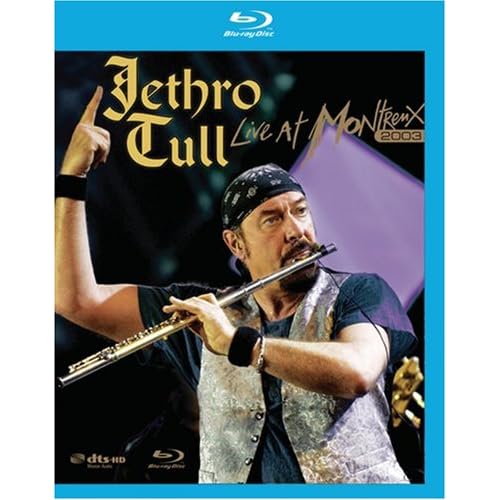
Jethro Tull, a swamp boogie blues band? You might be forgiven for thinking you've gotten a mispackaged Blu-Ray when you start up this 2003 Montreux concert. Sure, that looks like Ian Anderson and cohorts (notably longtime collaborator Martin Barre on guitars), but what is our fearless minstrel leader doing playing a harmonica? And why are the boys doing a down and dirty blues beat? That's just the beginning of a most unusual Tull concert that foregoes a lot of the tried and true material for some riskier choices, proving what incomparable innovators and superb musicans Anderson and company have always been.
While the back of the disc packaging claims the show is split into two halves, one acoustic, one electric, I found it to be much more diverse than that, with some reworkings of old favorites (Bach's "Bourree" played more like, well, a bourree, than the jazz waltz of the original Tull version) mixed with some lesser known newer songs. Anderson actually doesn't don his trademark flute until well into the concert, as a matter of fact. I've always thought Anderson's chops as a flautist have been widely underappreciated; he easily has one of the creamiest tones in the pop/jazz vernacular and while his improvising may not be of the caliber of, say, Hubert Laws, he is always inventive and never less than musical. Laws fans may find this disc of particular interest, as a matter of fact, because Anderson revists Gabriel Faure's beautiful "Pavane," recorded by Laws on one of his legendary CTi albums. Anderson recasts the tune in 3/4, giving it an almost Spanish flamenco flair once Barre's guitar takes over. It doesn't have the pyrotechnics of Laws' gorgeous version, but it has a unique and very inviting character of its own, something the rest of this concert shares.
Tull has a few surprises up its sleeve, including a strangely fringe-veiled woman named Masha who joins them on wordless vocals in a sort of world beat Middle Eastern tune. Even though the concert was taped in July, Anderson offers a spry lilting version of "God Rest Ye Merry Gentlemen" as well. They finally do get around to good old fashioned Tull material, including rousing versions of "Hunting Girl," "Living in the Past" (perhaps the best known song in 5/4 outside of Desmond's classic "Take Five"), "Aqualung" and "Locomotive Breath."
The Tull boys have always been showmen, and this concert is no exception. Anderson dances and weaves, Barre remains largely stoic while delivering solid solos, and keyboardist Andrew Giddings has a peculiar habit of lifting his right leg high into the air as he plays. Giddings and Barre have a kind of funny little showdown in the finale which brings the audience to rapturous approval. Tull has always been a band of considerable depth and contrapuntal complexity, and this Blu-Ray presentation shows that off in admirable detail. Anderson is nobody's fool, compositionally speaking, and his efforts bear repeated listening with ease.
About the only drawback of this concert is, sadly, Ian's voice. Whether he was simply tired, or it's the slow encroachment of advancing years (his singing of "Thin Man" is a little ironic since he's grown a middle-aged paunch), the once magisterial tones and long phrasings are nowhere to be heard here, and he struggles to hit a lot of the higher notes. He's always had a slightly nasal quality, but even that seems exaggerated throughout the concert, not always to enjoyable effect. Anderson contributes some charming liner notes to the Blu-Ray and states up front in them that the concert was filmed live and preserves the performance "warts and all," so I tend to want to cut him a little slack and say it's a minor wart given the instrumental magnificence that is routinely on display throughout the concert.
The Blu-Ray Disc
Video:
The image of this 1080i 1.78:1 transfer is startlingly clear, so clear in fact that we get occasional (perhaps unwanted) glimpses of Ian's nose hairs from foot of the stage camera angles. This is largely shot on a darkened stage, so don't expect a dazzling visual presentation, but colors and detail are completely solid, and I noticed no compression artifacts even without 1080p.
Sound:
Both the DD 5.1 and DTS 5.1 mixes are outstanding. Anderson and Barre usually take the front channels, which is as it should be, with drummer Doane Perry, bassist Jonathan Noyce and keysman Giddings bringing up the rear. Anderson's voice is sometimes slightly lost in the mix, which I think is more the fault of Ian jumping around the microphone than of the sound mix itself. There's some great rumbling lower frequencies with "Aqualung". There is also a standard LPCM stereo mix that is absolutely fine, though, again, Anderson's voice tends to be muddied at times.
Extras:
None are offered.
Final Thoughts:
This is visually and aurally one of the clearest home video releases of Tull ever, heads and shoulders above even some recent SD releases. Anderson's voice isn't all it should be, but that's about the only detriment. Highly recommended.
Review taken from DVD Talk. Click here for original article.


